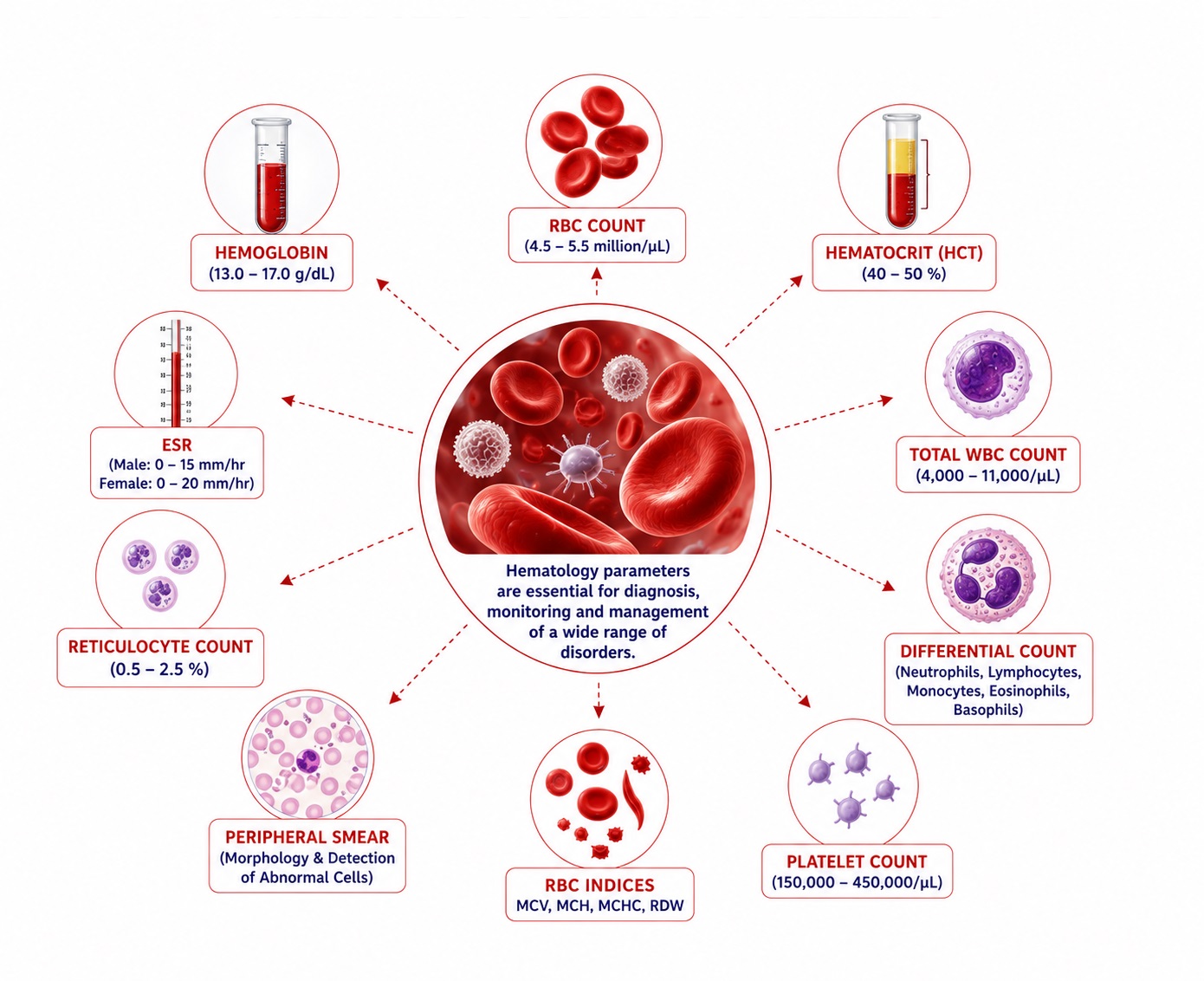
Hematology encompasses the study of blood cells, hematopoietic tissues, coagulation systems, and their associated disorders. Hematological reference intervals provide standardized quantitative benchmarks for evaluating erythrocyte, leukocyte, platelet, and coagulation function in healthy populations. These values are influenced by age, sex, ethnicity, altitude, physiological state, instrumentation, and laboratory methodology.
Erythrocyte (Red Blood Cell) Parameters
Red Blood Cell Count (RBC)
Red blood cells are anucleate biconcave cells responsible for oxygen and carbon dioxide transport.
| Parameter |
Adult Male |
Adult Female |
| RBC Count |
4.5–5.9 ×10¹²/L |
4.1–5.1 ×10¹²/L |
Morphological Characteristics
| Parameter |
Normal Value |
| Diameter |
7.0–8.0 μm |
| Thickness (Edge) |
2.0–2.5 μm |
| Thickness (Center) |
0.8–1.0 μm |
| Surface Area |
120–140 μm² |
| Volume |
80–100 fL |
| Lifespan |
120 days |
Hemoglobin (Hb)
Hemoglobin is the principal oxygen-carrying metalloprotein composed of globin chains and heme groups.
| Category |
Normal Range |
| Adult Male |
13.5–17.5 g/dL |
| Adult Female |
12.0–15.5 g/dL |
| Newborn |
14–24 g/dL |
Hematocrit (Packed Cell Volume; PCV)
| Category |
Normal Range |
| Adult Male |
41–53% |
| Adult Female |
36–46% |
Red Cell Indices
| Parameter |
Reference Range |
| Mean Corpuscular Volume (MCV) |
80–100 fL |
| Mean Corpuscular Hemoglobin (MCH) |
27–33 pg |
| Mean Corpuscular Hemoglobin Concentration (MCHC) |
32–36 g/dL |
| RDW-CV |
11.5–14.5% |
| RDW-SD |
39–46 fL |
Reticulocyte Parameters
Reticulocytes represent immature erythrocytes released from bone marrow following erythropoiesis.
Reticulocyte Count
| Parameter |
Normal Range |
| Relative Count |
0.5–2.5% |
| Absolute Count |
25–100 ×10⁹/L |
Advanced Reticulocyte Parameters
| Parameter |
Normal Range |
| Immature Reticulocyte Fraction (IRF) |
1.6–12.1% |
| Reticulocyte Hemoglobin Content (CHr) |
28–35 pg |
| Ret-He |
28–35 pg |
Hemoglobin Fractions
Adult Hemoglobin Composition
| Fraction |
Percentage |
| HbA (α₂β₂) |
95–98% |
| HbA₂ (α₂δ₂) |
2–3.5% |
| HbF (α₂γ₂) |
<1% |
Leukocyte Parameters
Total Leukocyte Count (TLC)
| Parameter |
Reference Range |
| WBC Count |
4.0–11.0 ×10⁹/L |
Differential Leukocyte Count (DLC)
Neutrophils
| Parameter |
Reference Range |
| Relative Count |
40–75% |
| Absolute Count |
2.0–7.5 ×10⁹/L |
| Morphology Characteristic |
Value |
| Diameter |
10–15 μm |
| Nuclear Lobes |
2–5 |
| Circulation Half-Life |
6–8 hours |
Lymphocytes
| Parameter |
Reference Range |
| Relative Count |
20–45% |
| Absolute Count |
1.0–4.0 ×10⁹/L |
| Morphology Characteristic |
Value |
| Diameter |
7–15 μm |
| Lifespan |
Days to years |
Monocytes
| Parameter |
Reference Range |
| Relative Count |
2–10% |
| Absolute Count |
0.2–0.8 ×10⁹/L |
| Morphology Characteristic |
Value |
| Diameter |
15–20 μm |
| Lifespan in Blood |
1–3 days |
Eosinophils
| Parameter |
Reference Range |
| Relative Count |
1–6% |
| Absolute Count |
0.02–0.5 ×10⁹/L |
| Morphology Characteristic |
Value |
| Diameter |
12–17 μm |
| Nuclear Lobes |
2 |
Basophils
| Parameter |
Reference Range |
| Relative Count |
0–1% |
| Absolute Count |
0–0.1 ×10⁹/L |
| Morphology Characteristic |
Value |
| Diameter |
10–14 μm |
Platelet Parameters
Platelets are anucleate cytoplasmic fragments derived from megakaryocytes.
Platelet Count
| Parameter |
Reference Range |
| Platelet Count |
150–450 ×10⁹/L |
Platelet Indices
| Parameter |
Reference Range |
| Mean Platelet Volume (MPV) |
7.5–11.5 fL |
| Platelet Distribution Width (PDW) |
9–17 fL |
| Plateletcrit (PCT) |
0.20–0.39% |
| Platelet Large Cell Ratio (P-LCR) |
13–43% |
| Immature Platelet Fraction (IPF) |
1–7% |
Morphological Characteristics
| Parameter |
Normal Value |
| Diameter |
2–4 μm |
| Lifespan |
7–10 days |
Erythrocyte Sedimentation Rate (ESR)
| Category |
Reference Range |
| Adult Male |
0–15 mm/hr |
| Adult Female |
0–20 mm/hr |
| Male >50 Years |
0–20 mm/hr |
| Female >50 Years |
0–30 mm/hr |
Iron Metabolism Parameters
Serum Iron
| Category |
Reference Range |
| Male |
65–175 μg/dL |
| Female |
50–170 μg/dL |
Ferritin
| Category |
Reference Range |
| Male |
30–400 ng/mL |
| Female |
15–150 ng/mL |
Total Iron Binding Capacity (TIBC)
| Parameter |
Reference Range |
| TIBC |
250–450 μg/dL |
Unsaturated Iron Binding Capacity (UIBC)
| Parameter |
Reference Range |
| UIBC |
150–375 μg/dL |
Transferrin Saturation
| Parameter |
Reference Range |
| Saturation |
20–50% |
Soluble Transferrin Receptor (sTfR)
| Parameter |
Reference Range |
| sTfR |
2.2–5.0 mg/L |
Coagulation Parameters
Primary Hemostasis
| Parameter |
Reference Range |
| Bleeding Time (Ivy Method) |
2–7 min |
| Platelet Function Analyzer (PFA-100 Closure Time) |
80–180 sec |
Secondary Hemostasis
| Parameter |
Reference Range |
| Prothrombin Time (PT) |
11–15 sec |
| INR |
0.8–1.2 |
| Activated Partial Thromboplastin Time (aPTT) |
25–35 sec |
| Thrombin Time (TT) |
14–21 sec |
| Reptilase Time |
14–20 sec |
Coagulation Factors
| Factor |
Plasma Activity |
| Factor I (Fibrinogen) |
200–400 mg/dL |
| Factor II |
50–150% |
| Factor V |
50–150% |
| Factor VII |
50–150% |
| Factor VIII |
50–150% |
| Factor IX |
50–150% |
| Factor X |
50–150% |
| Factor XI |
50–150% |
| Factor XII |
50–150% |
| Factor XIII |
50–150% |
Fibrinolytic Parameters
| Parameter |
Reference Range |
| D-Dimer |
<0.5 μg/mL FEU |
| Fibrin Degradation Products (FDP) |
<10 μg/mL |
| Plasminogen Activity |
80–120% |
| Antithrombin III |
80–120% |
| Protein C Activity |
70–140% |
| Protein S Activity |
60–140% |
Bone Marrow Parameters
Bone Marrow Cellularity
| Age Group |
Normal Cellularity |
| Adult |
30–70% |
Myeloid:Erythroid Ratio (M:E Ratio)
| Parameter |
Reference Range |
| M:E Ratio |
2:1–4:1 |
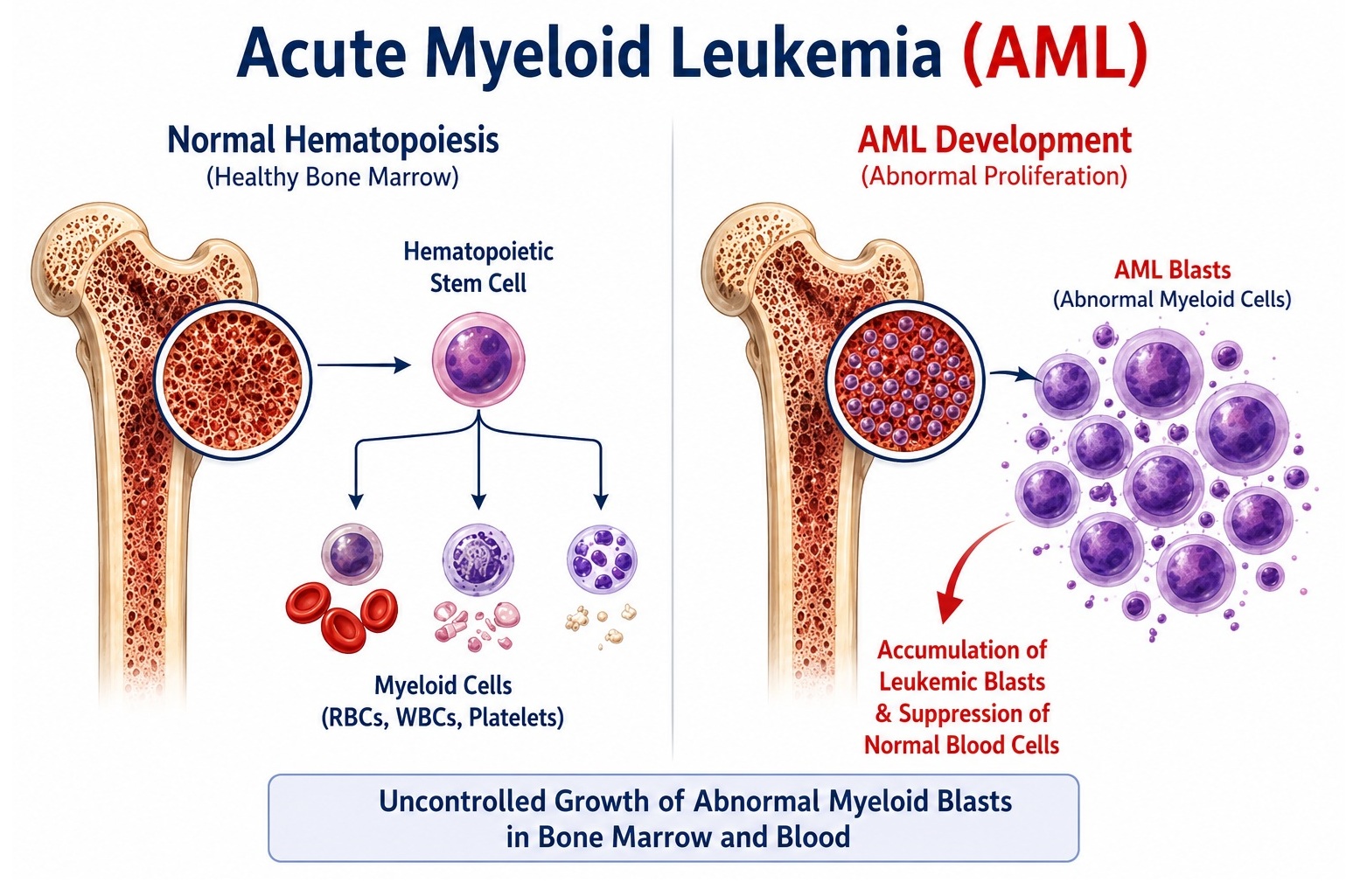
Blast Cells
| Parameter |
Reference Range |
| Marrow Blasts |
<5% |
Plasma Cells
| Parameter |
Reference Range |
| Plasma Cells |
<3% |
Megakaryocytes
| Parameter |
Reference Range |
| Megakaryocytes |
2–10 per low-power field |
Advanced Hematology Parameters (Modern Automated Analyzers)
| Parameter |
Reference Range |
| NRBC |
0/100 WBC |
| Ret-He |
28–35 pg |
| CHCM |
32–36 g/dL |
| MicroR |
<5% |
| MacroR |
<5% |
| Hypo-He |
<5% |
| Hyper-He |
<5% |
| Delta-He |
−2 to +2 pg |
| High Fluorescent Reticulocytes |
0–1% |
References
- Dacie and Lewis Practical Haematology. Bain BJ, Bates I, Laffan MA. Elsevier; 2021.
- Wintrobe's Clinical Hematology. Greer JP, Arber DA, Glader B, et al. Wolters Kluwer; 2023.
- Henry's Clinical Diagnosis and Management by Laboratory Methods. McPherson RA, Pincus MR. Elsevier; 2021.
- Rodak's Hematology: Clinical Principles and Applications. Keohane EM, Otto CN, Walenga JM. Elsevier; 2020.
- International Council for Standardization in Haematology (ICSH). ICSH Recommendations and Reference Methods for Hematology Laboratories.
- Clinical and Laboratory Standards Institute. Hematology and Coagulation Testing Guidelines.
- World Health Organization. Hemoglobin Concentrations for the Diagnosis of Anemia and Assessment of Severity.
- College of American Pathologists. Hematology and Coagulation Checklists.
- International Society on Thrombosis and Haemostasis. Guidelines on Coagulation and Hemostasis Testing.
- British Society for Haematology. Guidelines for Hematological Reference Ranges and Laboratory Practice.