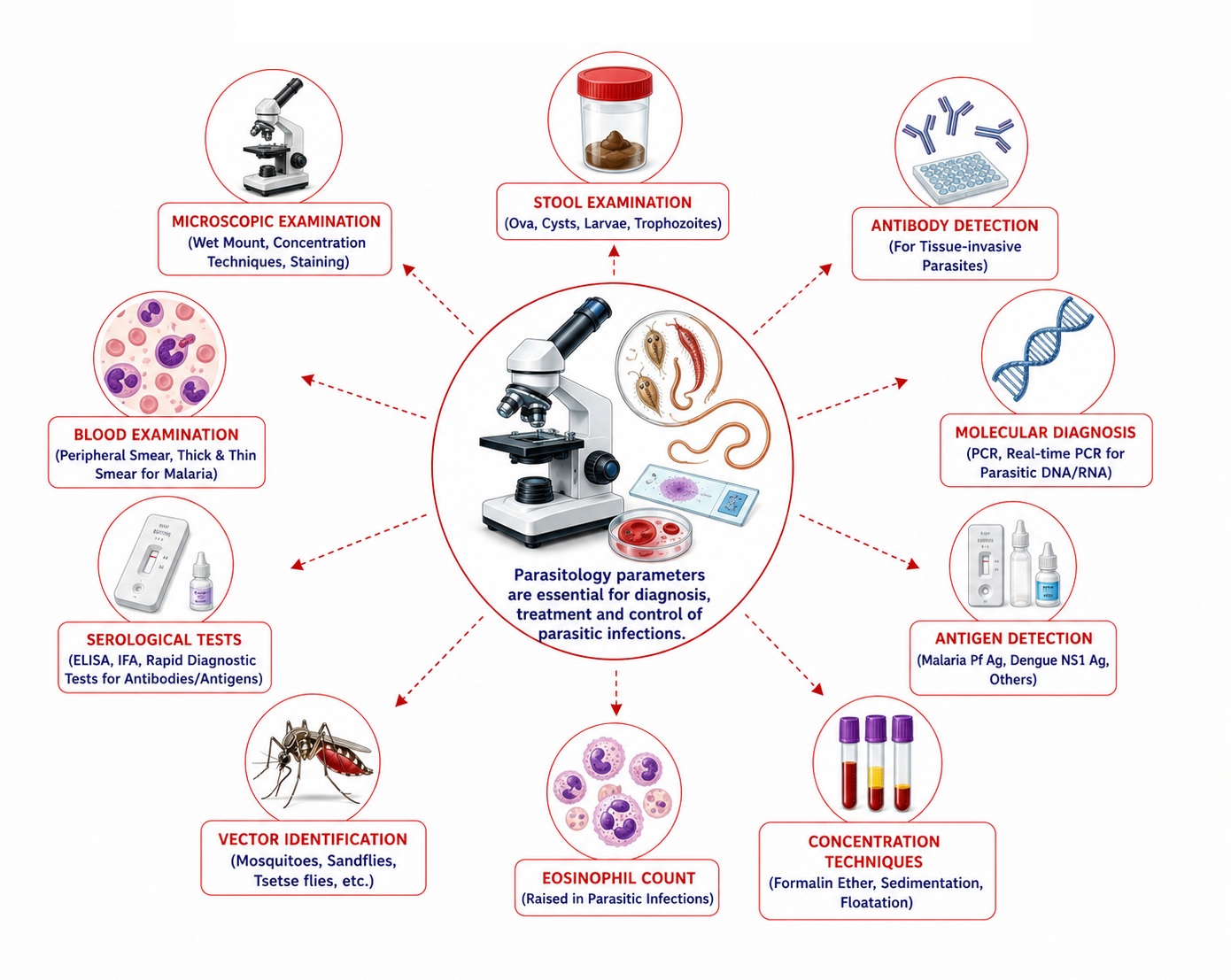
Parasitology is the branch of laboratory medicine concerned with the identification, characterization, quantification, and monitoring of protozoan, helminthic, and arthropod infections affecting humans. Unlike hematology and clinical biochemistry, parasitology does not rely on conventional physiological reference intervals; instead, it utilizes diagnostic reference parameters, parasitic burden measurements, morphological standards, microscopic indices, molecular thresholds, serological titers, vector characteristics, and epidemiological indicators. These parameters serve as benchmarks for the detection, classification, and assessment of parasitic infections in clinical, veterinary, public health, and research laboratories.
Stool Parasitology Parameters
Normal Stool Microscopy Findings
Macroscopic Examination
| Parameter |
Normal Finding |
| Color |
Brown |
| Consistency |
Formed |
| Blood |
Absent |
| Mucus |
Absent |
| Adult Worms |
Absent |
| Proglottids |
Absent |
Microscopic Examination
| Parameter |
Normal Finding |
| Protozoal Trophozoites |
Absent |
| Protozoal Cysts |
Absent |
| Helminth Eggs |
Absent |
| Helminth Larvae |
Absent |
| Oocysts |
Absent |
| RBCs |
Absent |
| WBCs |
Absent |
| Charcot-Leyden Crystals |
Absent |
Quantitative Fecal Egg Count Parameters
Kato-Katz Technique – Soil-Transmitted Helminths
Ascaris lumbricoides
| Infection Intensity |
Eggs per Gram (EPG) |
| Light |
1–4,999 |
| Moderate |
5,000–49,999 |
| Heavy |
≥50,000 |
Trichuris trichiura
| Infection Intensity |
EPG |
| Light |
1–999 |
| Moderate |
1,000–9,999 |
| Heavy |
≥10,000 |
Hookworm
| Infection Intensity |
EPG |
| Light |
1–1,999 |
| Moderate |
2,000–3,999 |
| Heavy |
≥4,000 |
Protozoology Parameters
Entamoeba histolytica
Trophozoite Morphology
| Parameter |
Reference Value |
| Size |
15–30 μm |
| Nuclei |
Single |
| Karyosome |
Central |
| Chromatin |
Fine Peripheral |
Cyst Morphology
| Parameter |
Reference Value |
| Size |
10–20 μm |
| Nuclei |
1–4 |
| Chromatoid Bodies |
Present |
Giardia duodenalis
Trophozoite
| Parameter |
Reference Value |
| Length |
12–15 μm |
| Width |
5–9 μm |
| Nuclei |
Two |
| Flagella |
Four Pairs |
Cyst
| Parameter |
Reference Value |
| Length |
8–14 μm |
| Width |
7–10 μm |
| Nuclei |
2–4 |
Blood Parasitology Parameters
Malaria Microscopy
Parasite Density Assessment
| Parameter |
Reference Value |
| Parasites/μL Blood |
0 (Normal) |
| Thick Smear WBC Count Basis |
200–500 WBCs |
| Standard WBC Count Used |
8,000/μL |
Parasite Density Formula
Parasites per μL = (Number of Parasites × 8000) ÷ Number of WBCs Counted
WHO Parasitemia Classification
| Parasitemia |
Parasites/μL |
| Low |
<1,000 |
| Moderate |
1,000–9,999 |
| High |
10,000–99,999 |
| Hyperparasitemia |
≥100,000 |
Plasmodium Species Morphology
Plasmodium falciparum
| Parameter |
Reference Value |
| Ring Size |
1–2 μm |
| Rings/RBC |
Multiple Common |
| Schizonts |
Rare in Peripheral Blood |
| Gametocyte Shape |
Crescent |
Plasmodium vivax
| Parameter |
Reference Value |
| Infected RBC Size |
Enlarged |
| Schizont Merozoites |
12–24 |
| Schüffner's Dots |
Present |
Filariasis Parameters
Microfilarial Measurements
Wuchereria bancrofti
| Parameter |
Reference Value |
| Length |
244–296 μm |
| Width |
7.5–10 μm |
| Sheath |
Present |
Brugia malayi
| Parameter |
Reference Value |
| Length |
177–230 μm |
| Width |
5–7 μm |
| Sheath |
Present |
Leishmaniasis Parameters
Amastigote (Leishman-Donovan Body)
| Parameter |
Reference Value |
| Size |
2–5 μm |
| Nucleus |
Single |
| Kinetoplast |
Present |
Bone Marrow Parasite Grading
| Grade |
Parasites/Field |
| 1+ |
1–10/1000 Fields |
| 2+ |
1–10/100 Fields |
| 3+ |
1–10/10 Fields |
| 4+ |
1–10/Field |
| 5+ |
10–100/Field |
| 6+ |
>100/Field |
Trypanosomiasis Parameters
Trypomastigote Morphology
| Parameter |
Reference Value |
| Length |
14–33 μm |
| Width |
1.5–3.5 μm |
| Flagellum |
Single |
| Kinetoplast |
Posterior |
Helminthology Parameters
Ascaris lumbricoides Egg Measurements
Fertilized Egg
| Parameter |
Reference Value |
| Length |
45–75 μm |
| Width |
35–50 μm |
Unfertilized Egg
| Parameter |
Reference Value |
| Length |
85–95 μm |
| Width |
43–47 μm |
Hookworm Egg
| Parameter |
Reference Value |
| Length |
60–75 μm |
| Width |
35–40 μm |
Trichuris trichiura Egg
| Parameter |
Reference Value |
| Length |
50–55 μm |
| Width |
22–24 μm |
| Polar Plugs |
Present |
Taenia spp. Egg
| Parameter |
Reference Value |
| Diameter |
30–40 μm |
| Radial Striations |
Present |
Cestode and Trematode Parameters
Schistosoma haematobium Egg
| Parameter |
Reference Value |
| Length |
110–170 μm |
| Width |
40–70 μm |
| Terminal Spine |
Present |
Schistosoma mansoni Egg
| Parameter |
Reference Value |
| Length |
114–180 μm |
| Width |
45–70 μm |
| Lateral Spine |
Present |
Serological Reference Parameters
Toxoplasma gondii
| Parameter |
Reference Value |
| IgG |
Negative |
| IgM |
Negative |
| IgG Avidity |
>60% (High Avidity) |
Echinococcus spp.
| Parameter |
Reference Value |
| ELISA Index |
Negative |
| Indirect Hemagglutination |
<1:64 |
Molecular Parasitology Parameters
Real-Time PCR
| Parameter |
Reference Value |
| PCR Efficiency |
90–110% |
| Correlation Coefficient (R²) |
≥0.99 |
| Ct Value Strong Positive |
<25 |
| Ct Value Moderate Positive |
25–30 |
| Ct Value Weak Positive |
30–35 |
| Negative Result |
Undetectable |
Entomological Parameters
Mosquito Vector Identification
Anopheles spp.
| Parameter |
Reference Value |
| Palpi Length |
Equal to Proboscis |
| Resting Position |
45° Angle |
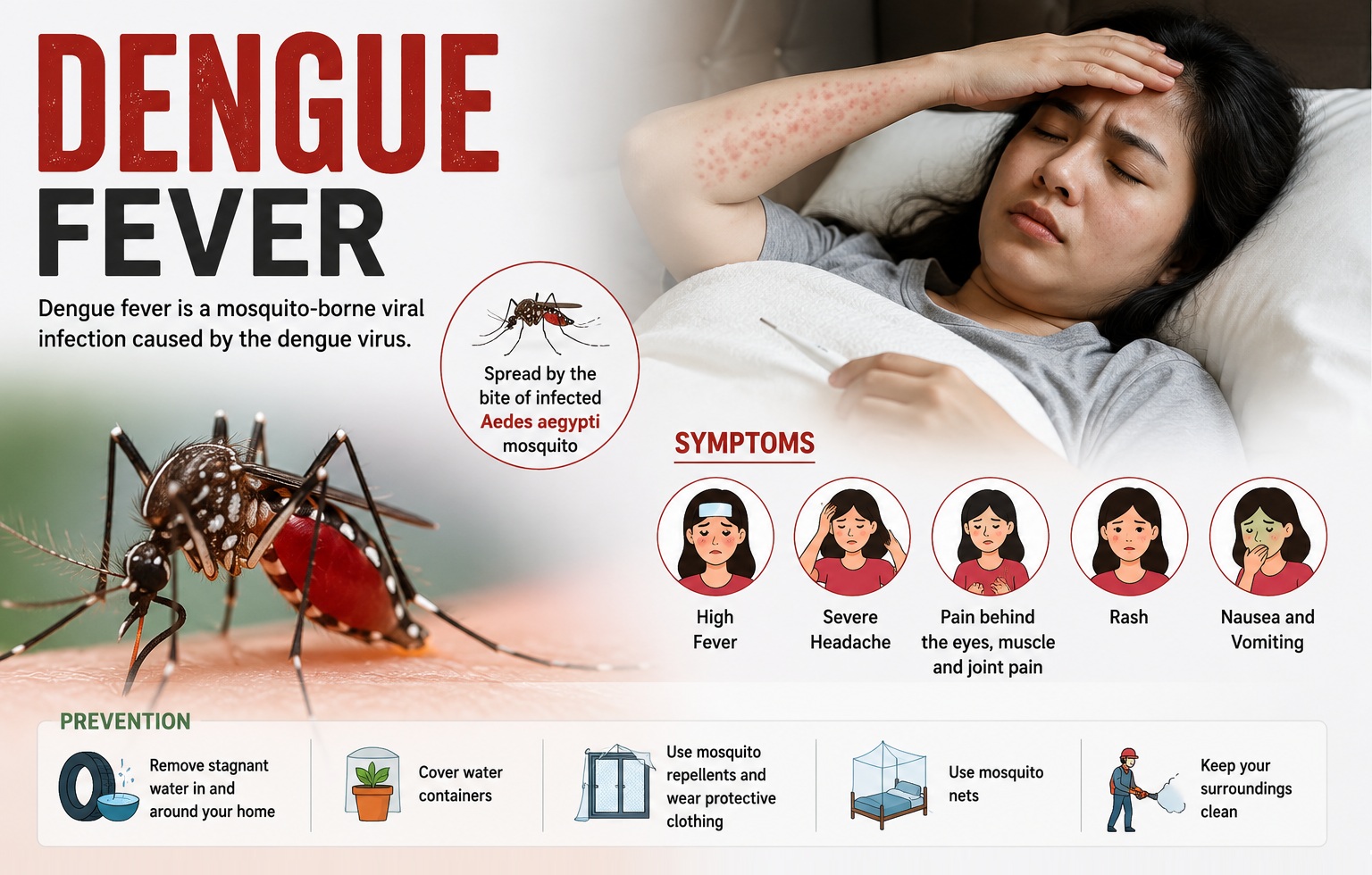
Aedes spp.
| Parameter |
Reference Value |
| Body Pattern |
Black with White Markings |
| Resting Position |
Parallel |
Quality Control Parameters in Diagnostic Parasitology
| Parameter |
Reference Value |
| Stool Fixative pH |
6.8–7.2 |
| Formalin Concentration |
10% |
| Lugol's Iodine Strength |
1% |
| Giemsa Stain pH |
7.2 |
| Incubation Temperature |
35–37°C |
| Refrigerator Storage |
2–8°C |
| Cryopreservation |
−70°C to −80°C |
References
- Garcia's Diagnostic Medical Parasitology.
- Markell and Voge's Medical Parasitology.
- Paniker's Textbook of Medical Parasitology.
- World Health Organization.
- World Health Organization.
- Centers for Disease Control and Prevention.
- Clinical Parasitology.
- Diagnostic Parasitology for Veterinary Technicians.
- American Society of Tropical Medicine and Hygiene.
- Clinical and Laboratory Standards Institute.