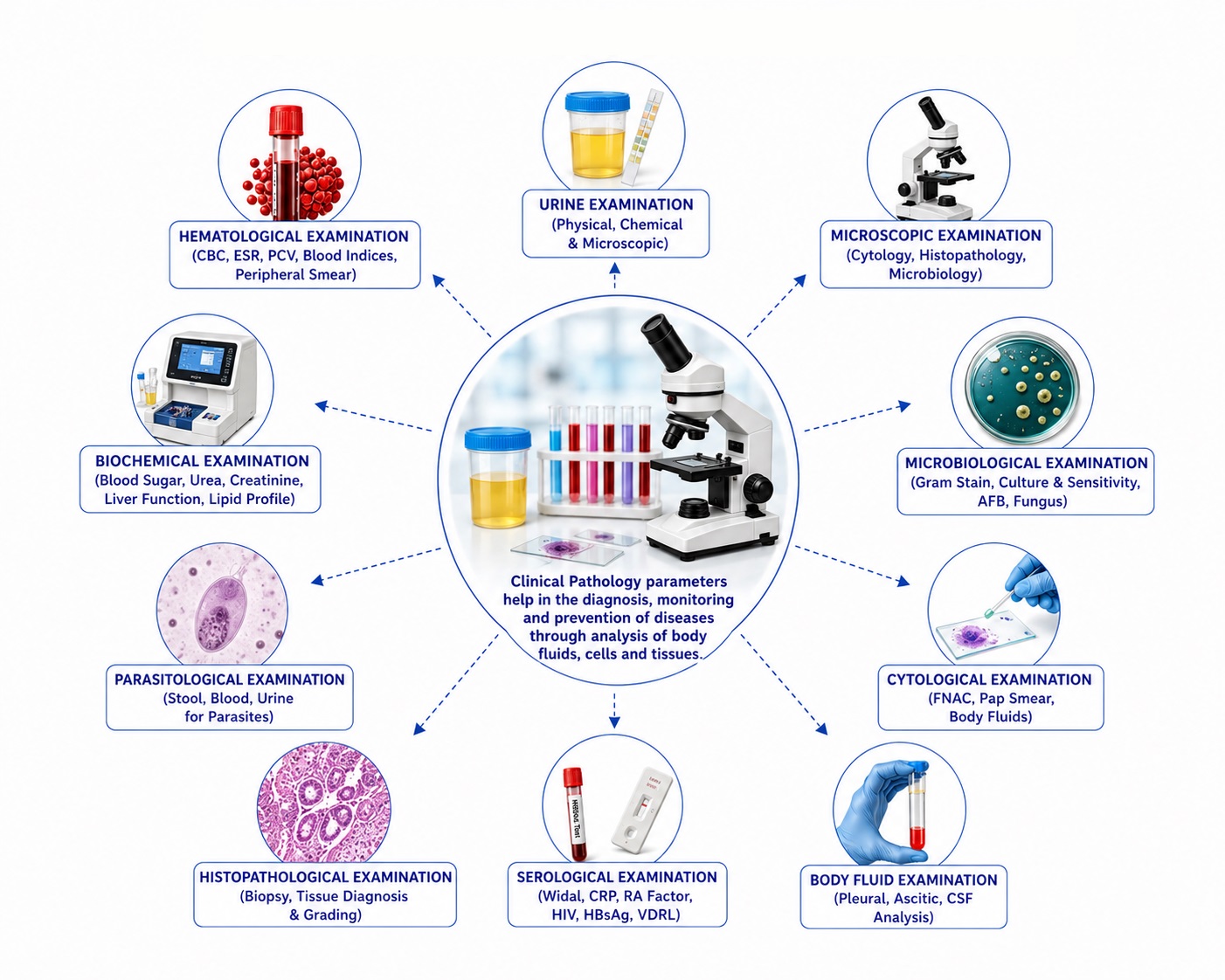
Clinical Pathology encompasses the laboratory examination of body fluids, excreta, cellular elements, and microscopic specimens for the diagnosis, monitoring, and prognosis of diseases. Unlike hematology or clinical biochemistry, clinical pathology integrates physical, chemical, microscopic, cytological, and microbiological analyses of urine, cerebrospinal fluid, serous fluids, synovial fluid, semen, sputum, gastric fluid, and stool specimens. Reference values provide essential benchmarks for interpreting laboratory findings and distinguishing normal physiological states from pathological conditions.
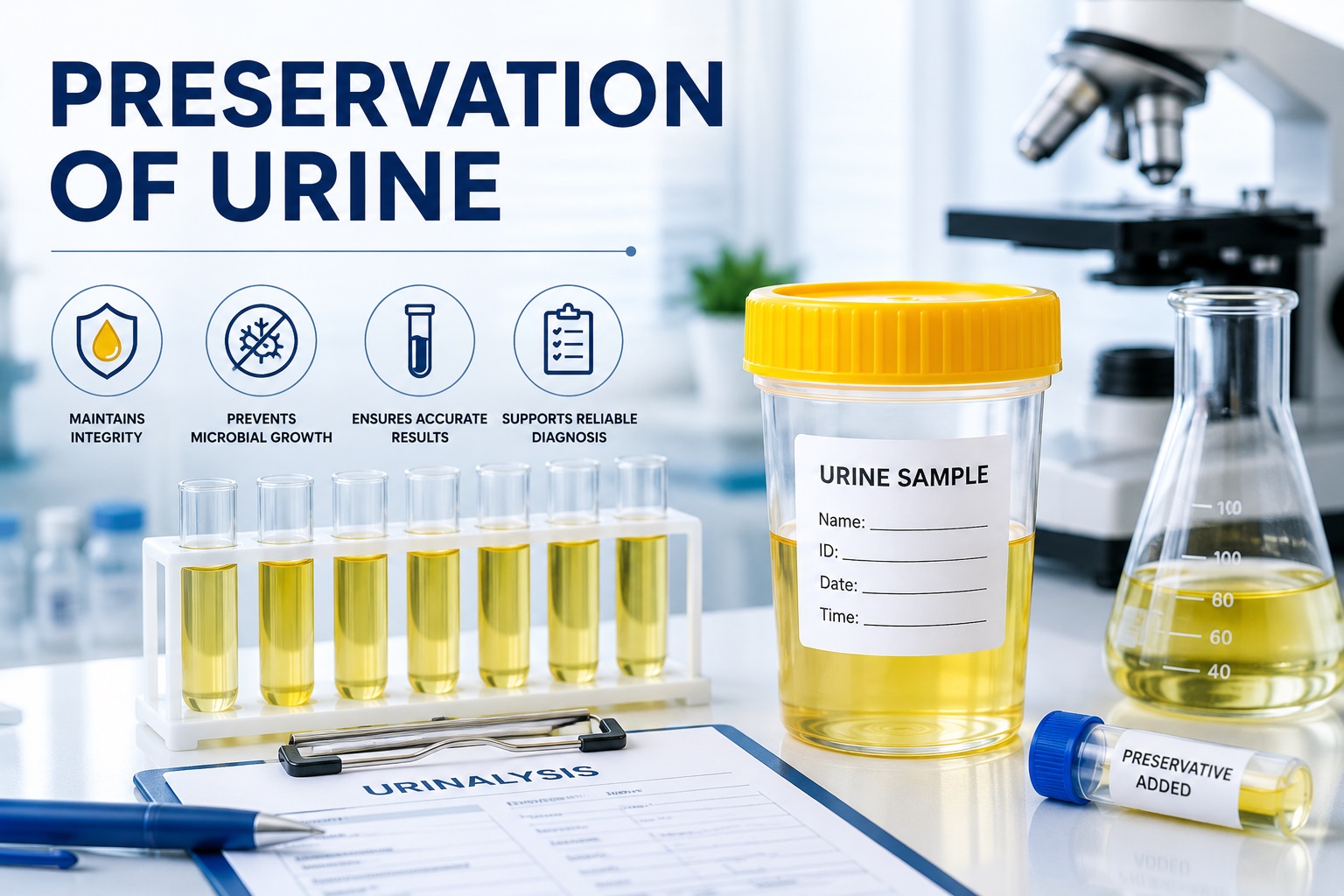
Urinalysis
Physical Examination
| Parameter |
Normal Value |
| Daily Urine Output |
800–2000 mL/day |
| Specific Gravity |
1.005–1.030 |
| Osmolality |
300–900 mOsm/kg |
| Color |
Pale Yellow–Amber |
| Appearance |
Clear |
| pH |
4.5–8.0 |
| Odor |
Aromatic |
Twenty-Four Hour Urinary Excretion
| Parameter |
Normal Value |
| Protein |
<150 mg/day |
| Albumin |
<30 mg/day |
| Creatinine (Male) |
14–26 mg/kg/day |
| Creatinine (Female) |
11–20 mg/kg/day |
| Calcium |
100–300 mg/day |
| Uric Acid |
250–750 mg/day |
| Sodium |
40–220 mmol/day |
| Potassium |
25–125 mmol/day |
| Chloride |
110–250 mmol/day |
Chemical Examination
| Parameter |
Normal Finding |
| Glucose |
Negative |
| Ketones |
Negative |
| Bilirubin |
Negative |
| Blood |
Negative |
| Protein |
Negative |
| Nitrite |
Negative |
| Leukocyte Esterase |
Negative |
| Urobilinogen |
0.1–1.0 EU/dL |
Microscopic Examination
| Parameter |
Normal Value |
| RBCs |
0–2/HPF |
| WBCs |
0–5/HPF |
| Renal Tubular Cells |
Rare |
| Squamous Epithelial Cells |
0–5/HPF |
| Transitional Cells |
Occasional |
| Hyaline Casts |
0–2/LPF |
| Granular Casts |
Absent |
| Waxy Casts |
Absent |
| RBC Casts |
Absent |
| WBC Casts |
Absent |
| Bacteria |
None–Rare |
| Yeast |
Absent |
Cerebrospinal Fluid (CSF)
Physical Characteristics
| Parameter |
Normal Value |
| Volume |
90–150 mL |
| Production Rate |
450–600 mL/day |
| Opening Pressure |
10–20 cm H₂O |
| Specific Gravity |
1.006–1.008 |
| Appearance |
Clear |
| Color |
Colorless |
Chemical Analysis
| Parameter |
Normal Value |
| Protein |
15–45 mg/dL |
| Albumin |
10–30 mg/dL |
| Glucose |
50–80 mg/dL |
| Lactate |
1.1–2.4 mmol/L |
| Chloride |
118–132 mmol/L |
| Immunoglobulin G |
0–6 mg/dL |
Cytological Examination
| Parameter |
Normal Value |
| Total Cell Count |
0–5 Cells/μL |
| Lymphocytes |
60–70% |
| Monocytes |
30–40% |
| Neutrophils |
Absent |
| Eosinophils |
Absent |
| Plasma Cells |
Absent |
Pleural Fluid Analysis
Physical Parameters
| Parameter |
Normal Value |
| Volume |
5–15 mL |
| Appearance |
Clear |
| Color |
Pale Yellow |
| Specific Gravity |
<1.016 |
Chemical Parameters
| Parameter |
Normal Value |
| Protein |
<2.0 g/dL |
| Albumin |
<1.5 g/dL |
| Glucose |
Similar to Serum |
| LDH |
<200 U/L |
| pH |
7.60–7.66 |
Cellular Components
| Parameter |
Normal Value |
| Total Cells |
<1000/μL |
| Mesothelial Cells |
Few |
| Neutrophils |
Rare |
| Lymphocytes |
Predominant |
Peritoneal (Ascitic) Fluid Analysis
Physical Parameters
| Parameter |
Normal Value |
| Volume |
<50 mL |
| Appearance |
Clear |
| Color |
Straw Colored |
Chemical Parameters
| Parameter |
Normal Value |
| Protein |
<3.0 g/dL |
| Albumin |
Variable |
| Glucose |
Similar to Serum |
| LDH |
Lower Than Serum |
Microscopic Examination
| Parameter |
Normal Value |
| WBC Count |
<500 Cells/μL |
| PMN Count |
<250 Cells/μL |
| Mesothelial Cells |
Present |
Pericardial Fluid Analysis
| Parameter |
Normal Value |
| Volume |
15–50 mL |
| Appearance |
Clear |
| Protein |
<2.0 g/dL |
| WBC Count |
<1000 Cells/μL |
| pH |
7.40–7.60 |
Synovial Fluid Analysis
Physical Characteristics
| Parameter |
Normal Value |
| Volume |
<3.5 mL |
| Color |
Colorless–Pale Yellow |
| Clarity |
Transparent |
| Viscosity |
High |
Chemical Analysis
| Parameter |
Normal Value |
| Protein |
1–3 g/dL |
| Glucose |
Within 10 mg/dL of Serum |
| Lactate |
<10 mg/dL |
Cellular Analysis
| Parameter |
Normal Value |
| WBC Count |
<200/μL |
| Neutrophils |
<25% |
| Lymphocytes |
Predominant |
| Crystals |
Absent |
Semen Analysis
Macroscopic Examination
| Parameter |
WHO Reference Value |
| Volume |
≥1.4 mL |
| pH |
7.2–8.0 |
| Liquefaction Time |
≤60 min |
| Appearance |
Grayish White |
| Viscosity |
Normal |
Microscopic Examination
| Parameter |
Reference Value |
| Sperm Concentration |
≥16 Million/mL |
| Total Sperm Count |
≥39 Million |
| Total Motility |
≥42% |
| Progressive Motility |
≥30% |
| Vitality |
≥54% |
| Normal Morphology |
≥4% |
Stool Examination
Physical Examination
| Parameter |
Normal Value |
| Weight |
100–200 g/day |
| Water Content |
60–75% |
| Color |
Brown |
| pH |
6.5–7.5 |
Chemical Examination
| Parameter |
Normal Value |
| Occult Blood |
Negative |
| Fecal Fat |
<7 g/day |
| Reducing Substances |
Negative |
Microscopic Examination
| Parameter |
Normal Value |
| RBCs |
Absent |
| WBCs |
Absent |
| Ova |
Absent |
| Cysts |
Absent |
| Parasites |
Absent |
| Yeast Cells |
Rare |
Sputum Examination
Physical Examination
| Parameter |
Normal Value |
| Volume |
10–100 mL/day |
| Color |
Clear–White |
| Appearance |
Mucoid |
Microscopic Examination
| Parameter |
Normal Value |
| Squamous Epithelial Cells |
<10/LPF |
| Neutrophils |
Minimal |
| Macrophages |
Present |
| AFB |
Absent |
| Fungal Elements |
Absent |
Gastric Analysis
| Parameter |
Normal Value |
| Gastric Juice Volume |
20–100 mL |
| pH |
1.5–3.5 |
| Free HCl |
20–40 mEq/L |
| Total Acidity |
20–60 mEq/L |
Amniotic Fluid Analysis
| Parameter |
Normal Value |
| Volume at Term |
500–1000 mL |
| pH |
7.0–7.5 |
| Specific Gravity |
1.006–1.010 |
| Bilirubin (ΔOD450) |
Normal Liley Zone I |
Cytopathology Parameters
Cervicovaginal Cytology (Bethesda System)
| Parameter |
Normal Finding |
| Squamous Cells |
Normal Maturation |
| Endocervical Cells |
Present |
| Intraepithelial Lesion |
Absent |
| Malignant Cells |
Absent |
Body Fluid Cytology
| Parameter |
Normal Finding |
| Mesothelial Cells |
Present |
| Macrophages |
Few |
| Reactive Cells |
Minimal |
| Malignant Cells |
Absent |
Sweat Analysis
| Parameter |
Normal Value |
| Sweat Chloride |
<30 mmol/L |
| Sweat Sodium |
10–70 mmol/L |
| Sweat Potassium |
10–20 mmol/L |
References
- Henry's Clinical Diagnosis and Management by Laboratory Methods
- Tietz Textbook of Clinical Chemistry and Molecular Diagnostics
- Clinical Laboratory Medicine
- Strasinger's Urinalysis and Body Fluids
- Graff's Textbook of Urinalysis and Body Fluids
- Clinical and Laboratory Standards Institute
- International Federation of Clinical Chemistry and Laboratory Medicine
- World Health Organization
- College of American Pathologists
- International Academy of Cytology