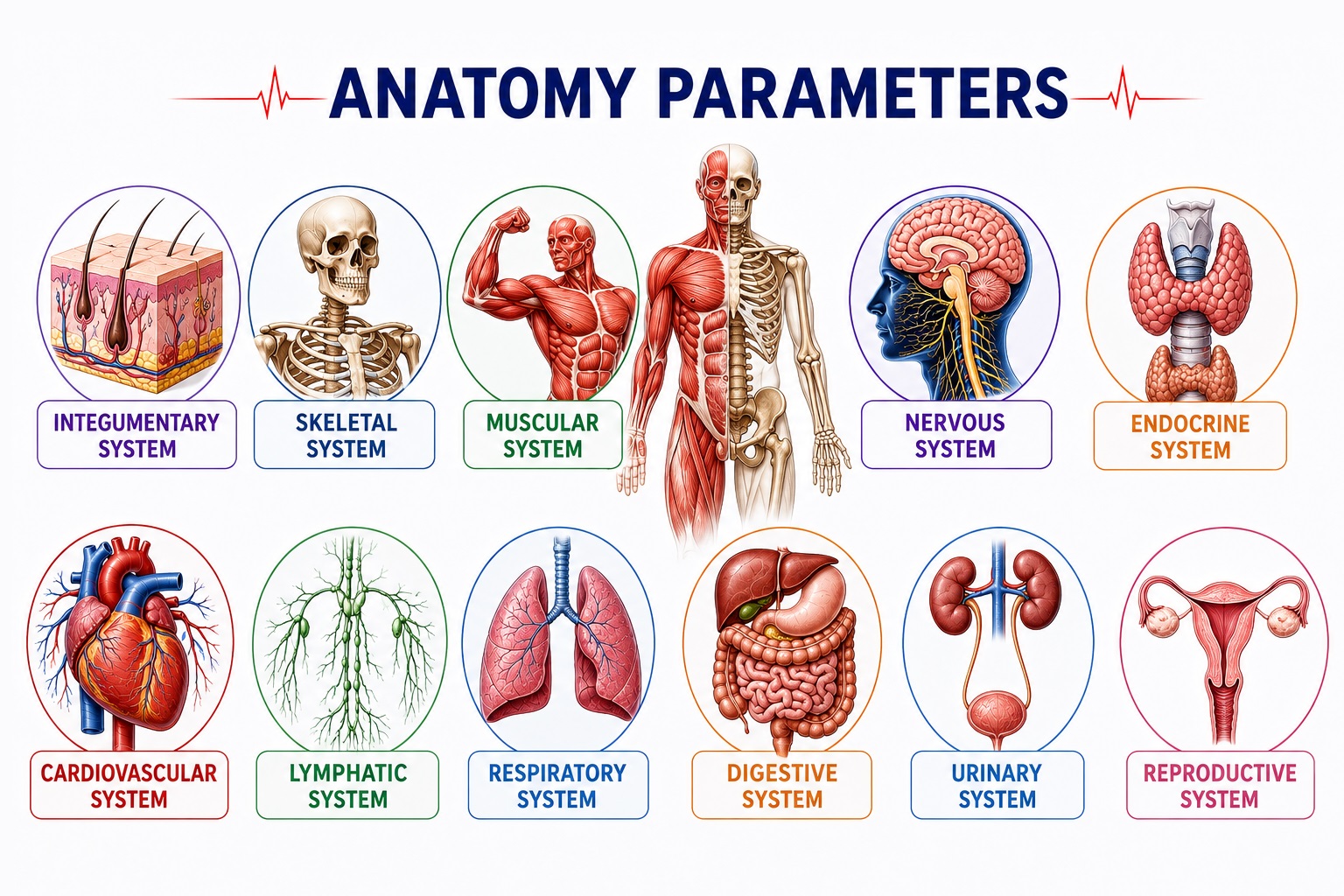
Anatomical parameters represent the normal structural dimensions, weights, volumes, counts, and measurements of organs, tissues, and body systems in healthy individuals. These reference values are fundamental in anatomy, radiology, pathology, surgery, and clinical medicine for identifying normal variations and detecting abnormalities.
1. Integumentary System
The integumentary system consists of the skin, hair, nails, sweat glands, and sebaceous glands. It serves as the body's primary protective barrier.
Skin Measurements
| Parameter |
Normal Value |
| Total skin surface area (adult) |
1.5–2.0 m² |
| Skin weight |
4–5 kg |
| Percentage of body weight |
15–16% |
| Epidermal thickness |
0.05–1.5 mm |
| Dermal thickness |
1–4 mm |
| Hypodermis thickness |
Variable (1 mm–3 cm) |
| Skin pH |
4.5–5.5 |
Hair
| Parameter |
Normal Value |
| Total body hair follicles |
~5 million |
| Scalp hair follicles |
80,000–120,000 |
| Average hair growth |
1–1.5 cm/month |
| Daily hair shedding |
50–100 hairs/day |
Nails
| Parameter |
Normal Value |
| Fingernail growth rate |
3 mm/month |
| Toenail growth rate |
1 mm/month |
| Fingernail replacement |
4–6 months |
| Toenail replacement |
12–18 months |
Glands
| Parameter |
Normal Value |
| Sweat glands |
2–4 million |
| Sebaceous glands |
~200,000 |
2. Skeletal System
The skeletal system provides support, protection, mineral storage, and attachment sites for muscles.
Bone Count
| Parameter |
Normal Value |
| Adult bones |
206 |
| Neonatal bones |
270–300 |
| Skull bones |
22 |
| Auditory ossicles |
6 |
| Hyoid bone |
1 |
| Vertebrae |
33 |
| Ribs |
24 |
| Sternum |
1 |
Bone Composition
| Component |
Percentage |
| Compact bone |
80% |
| Cancellous bone |
20% |
| Water content |
25% |
| Organic matrix |
30% |
| Inorganic minerals |
45% |
Vertebral Column
| Region |
Vertebrae |
| Cervical |
7 |
| Thoracic |
12 |
| Lumbar |
5 |
| Sacral |
5 fused |
| Coccygeal |
4 fused |
Joint Classification
| Joint Type |
Number |
| Fibrous |
~25 |
| Cartilaginous |
~70 |
| Synovial |
~230 |
3. Muscular System
The muscular system is responsible for movement, posture, and heat generation.
General Measurements
| Parameter |
Normal Value |
| Total muscles |
>600 |
| Skeletal muscle percentage |
40–50% body weight |
| Smooth muscle percentage |
5–10% |
| Cardiac muscle percentage |
<1% |
Muscle Fiber Distribution
| Fiber Type |
Approximate Percentage |
| Type I (Slow-twitch) |
40–60% |
| Type IIa |
20–35% |
| Type IIx |
15–30% |
Strength Reference
| Parameter |
Male |
Female |
| Handgrip strength |
40–60 kg |
25–40 kg |
4. Nervous System
The nervous system coordinates sensory, motor, and cognitive functions.
Brain
| Parameter |
Normal Value |
| Adult male brain weight |
1300–1400 g |
| Adult female brain weight |
1200–1300 g |
| Cerebrum weight |
~1200 g |
| Cerebellum weight |
~150 g |
| Brain volume |
1200–1400 mL |
Neurons
| Parameter |
Normal Value |
| Total neurons |
~86 billion |
| Glial cells |
~85 billion |
| Axon diameter |
0.1–20 μm |
| Myelin thickness |
1–10 μm |
Cranial Nerves
| Parameter |
Normal Value |
| Cranial nerves |
12 pairs |
| Spinal nerves |
31 pairs |
5. Endocrine System
The endocrine system regulates metabolism, growth, development, and reproduction.
Endocrine Glands
| Gland |
Normal Weight |
| Pituitary |
0.5–1 g |
| Pineal |
100–180 mg |
| Thyroid |
15–25 g |
| Parathyroid |
30–50 mg each |
| Adrenal |
4–6 g each |
| Pancreas |
70–120 g |
| Thymus (adult) |
20–50 g |
Thyroid Dimensions
| Parameter |
Normal Value |
| Length |
4–6 cm |
| Width |
1.5–2 cm |
| Thickness |
1–2 cm |
6. Cardiovascular System
The cardiovascular system circulates blood throughout the body.
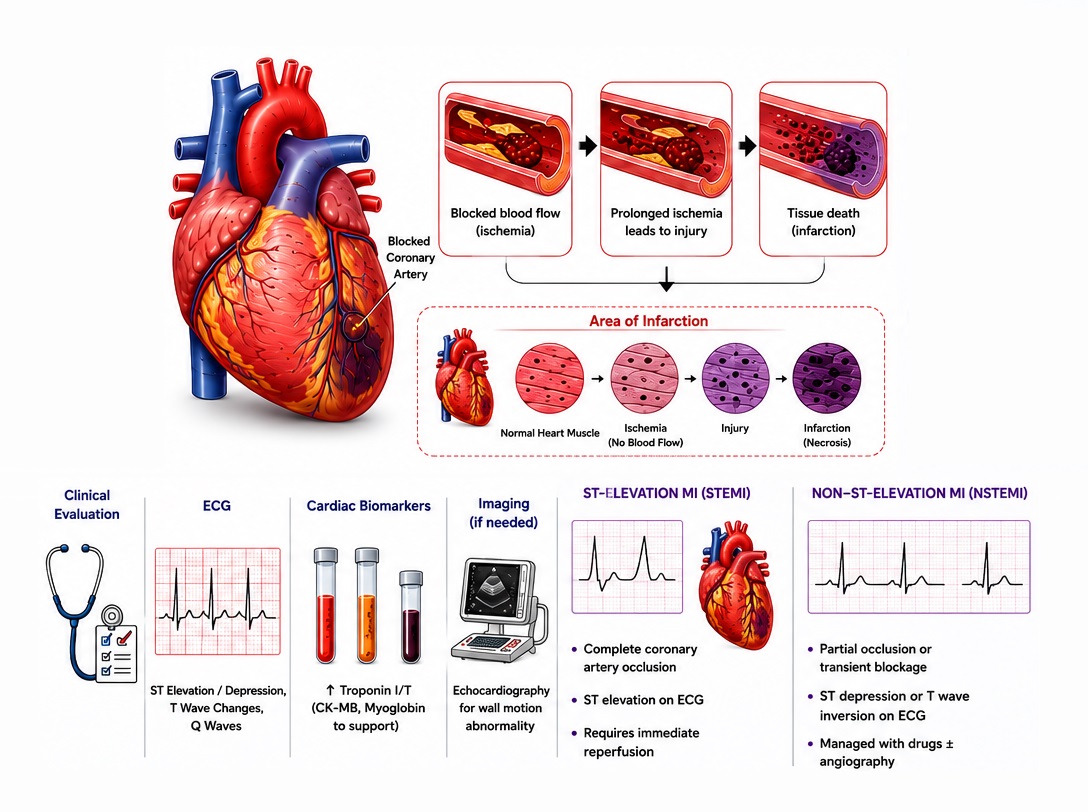
Heart
| Parameter |
Normal Value |
| Weight (male) |
280–340 g |
| Weight (female) |
230–280 g |
| Length |
12 cm |
| Width |
8–9 cm |
| Thickness |
6 cm |
Coronary Arteries
| Parameter |
Normal Diameter |
| Left main coronary artery |
3–6 mm |
| Right coronary artery |
2–4 mm |
Major Vessels
| Vessel |
Diameter |
| Ascending aorta |
25–35 mm |
| Aortic arch |
20–30 mm |
| Pulmonary artery |
20–25 mm |
| Inferior vena cava |
15–25 mm |
7. Lymphatic System
The lymphatic system is involved in immunity and fluid balance.
Lymphatic Structures
| Parameter |
Normal Value |
| Lymph nodes |
500–700 |
| Thoracic duct length |
38–45 cm |
| Thoracic duct diameter |
2–5 mm |
| Spleen weight |
150–200 g |
| Spleen length |
10–12 cm |
| Tonsil size |
2–3 cm |
Lymph Node Size
| Region |
Maximum Normal Diameter |
| Cervical |
<10 mm |
| Axillary |
<10 mm |
| Inguinal |
<15 mm |
8. Respiratory System
The respiratory system performs gas exchange.
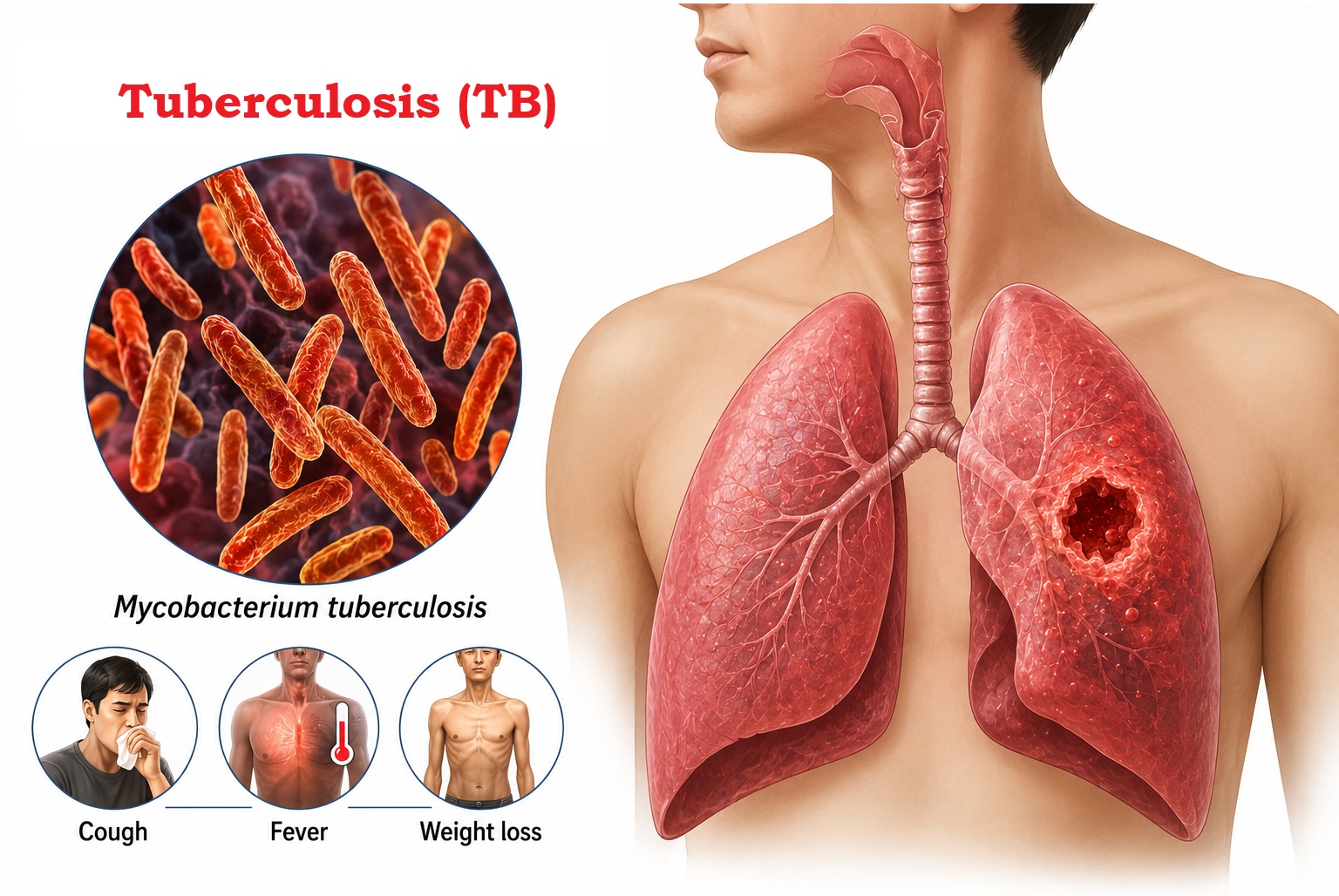
Respiratory Anatomy
| Parameter |
Normal Value |
| Trachea length |
10–12 cm |
| Trachea diameter |
2–2.5 cm |
| Right lung weight |
450–600 g |
| Left lung weight |
375–500 g |
Bronchial Tree
| Parameter |
Normal Value |
| Tracheal bifurcation level |
T4–T5 |
| Bronchial generations |
~23 |
Lung Volumes
| Parameter |
Male |
Female |
| Tidal volume |
500 mL |
500 mL |
| Inspiratory reserve volume |
3000 mL |
1900 mL |
| Expiratory reserve volume |
1100 mL |
700 mL |
| Residual volume |
1200 mL |
1100 mL |
| Vital capacity |
4800 mL |
3600 mL |
| Total lung capacity |
6000 mL |
4800 mL |
9. Digestive System
The digestive system processes food and absorbs nutrients.
Gastrointestinal Tract Length
| Structure |
Length |
| Oral cavity |
5–7 cm |
| Pharynx |
12–14 cm |
| Esophagus |
25 cm |
| Stomach |
25–30 cm |
| Duodenum |
25 cm |
| Jejunum |
2.5 m |
| Ileum |
3.5 m |
| Large intestine |
1.5 m |
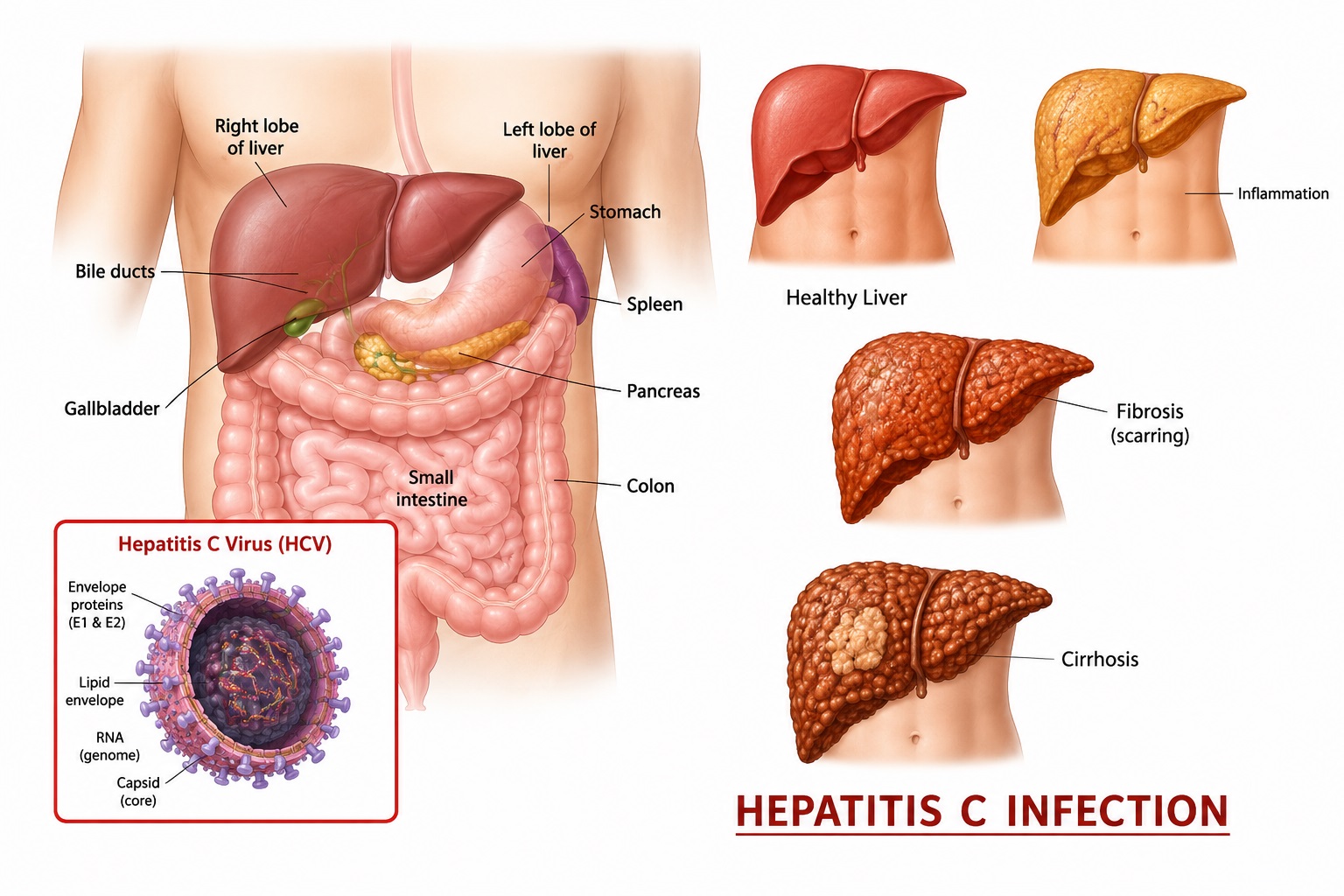
Liver
| Parameter |
Normal Value |
| Weight |
1400–1800 g |
| Length |
15–17 cm |
| Width |
10–12 cm |
Pancreas
| Parameter |
Normal Value |
| Length |
12–15 cm |
| Weight |
70–120 g |
Gallbladder
| Parameter |
Normal Value |
| Length |
7–10 cm |
| Capacity |
30–60 mL |
10. Urinary System
The urinary system maintains fluid and electrolyte balance.
Kidneys
| Parameter |
Normal Value |
| Length |
10–12 cm |
| Width |
5–7 cm |
| Thickness |
3–4 cm |
| Weight |
120–170 g |
Nephrons
| Parameter |
Normal Value |
| Nephrons per kidney |
0.8–1.5 million |
Urinary Tract
| Parameter |
Normal Value |
| Ureter length |
25–30 cm |
| Male urethra |
18–20 cm |
| Female urethra |
3–5 cm |
| Bladder capacity |
400–600 mL |
11. Reproductive System
Male Reproductive System
Testes
| Parameter |
Normal Value |
| Length |
4–6 cm |
| Width |
2–3 cm |
| Weight |
15–25 g |
Prostate
| Parameter |
Normal Value |
| Weight |
15–25 g |
| Width |
4 cm |
| Length |
3 cm |
Seminal Vesicles
| Parameter |
Normal Value |
| Length |
5 cm |
Female Reproductive System
Uterus
| Parameter |
Normal Value |
| Length |
7–8 cm |
| Width |
4–5 cm |
| Thickness |
2–3 cm |
| Weight |
50–80 g |
Ovaries
| Parameter |
Normal Value |
| Length |
2.5–5 cm |
| Width |
1.5–3 cm |
| Volume |
5–10 cm³ |
Fallopian Tubes
| Parameter |
Normal Value |
| Length |
10–12 cm |
Vagina
| Parameter |
Normal Value |
| Length |
7–10 cm |
Key Clinical Applications
These anatomical reference values are used for:
- Physical examination
- Radiological interpretation (X-ray, CT, MRI, Ultrasound)
- Surgical planning
- Organ size assessment
- Congenital anomaly detection
- Growth and developmental evaluation
- Forensic medicine
- Medical education and research
Understanding normal anatomical parameters allows healthcare professionals to accurately identify structural abnormalities and assess disease-related changes across all body systems.
References
The following standard anatomy textbooks and atlases were used as authoritative sources for normal anatomical measurements, dimensions, organ weights, and structural parameters:
- Gray's Anatomy. Standring S, editor. Gray's Anatomy: The Anatomical Basis of Clinical Practice. 42nd ed. London: Elsevier; 2023.
- Gray's Anatomy for Students. Drake RL, Vogl AW, Mitchell AWM. Gray's Anatomy for Students. 4th ed. Philadelphia: Elsevier; 2023.
- Clinically Oriented Anatomy. Moore KL, Dalley AF, Agur AMR. 8th ed. Philadelphia: Wolters Kluwer; 2021.
- Essential Clinical Anatomy. Moore KL, Agur AMR, Dalley AF. 7th ed. Philadelphia: Elsevier; 2023.
- Human Anatomy. Martini FH, Timmons MJ, Tallitsch RB. 8th ed. New York: Pearson Education; 2017.
- Principles of Human Anatomy. Tortora GJ, Nielsen MT. 15th ed. New York: Wiley; 2017.
- Atlas of Human Anatomy. Netter FH. 8th ed. Philadelphia: Elsevier; 2022.
- Clinical Anatomy by Regions. Richard S. Snell. 10th ed. Philadelphia: Wolters Kluwer; 2018.
- Clinical Neuroanatomy. Snell RS. 9th ed. New York: McGraw-Hill Education; 2019.
- The Human Brain. Nolte J. 7th ed. Philadelphia: Elsevier Academic Press; 2016.
- Ross and Wilson Anatomy and Physiology in Health and Illness. Waugh A, Grant A. 14th ed. Edinburgh: Elsevier; 2022.
- Sobotta Atlas of Human Anatomy. Paulsen F, Waschke J. 17th ed. Munich: Elsevier; 2024.
- The Developing Human. Moore KL, Persaud TVN, Torchia MG. 11th ed. Philadelphia: Elsevier; 2019.
- Federative International Programme for Anatomical Terminology. Terminologia Anatomica: International Anatomical Terminology. 2nd ed. Stuttgart: Thieme; 2019.
- International Federation of Associations of Anatomists. International standards and nomenclature for human anatomical structures.