






Preservation of Urine Specimens – Principles, Methods and Clinical Significance
Urine is one of the most frequently examined biological specimens in clinical laboratory practice and serves as an invaluable source of information regarding renal function, metabolic status, endocrine disorders, urinary tract diseases, and various systemic illnesses. The diagnostic value of urinalysis, however, depends not only upon the analytical procedures performed in the laboratory but also upon the quality and integrity of the specimen submitted for examination. Once urine is voided from the urinary bladder, it ceases to be a stable biological fluid and immediately becomes subject to a series of physical, chemical, and microbiological changes. These changes continue progressively during storage and transportation and may significantly alter the composition of the specimen. Consequently, the results obtained from a poorly preserved urine sample may no longer accurately reflect the patient's physiological or pathological condition at the time of collection. 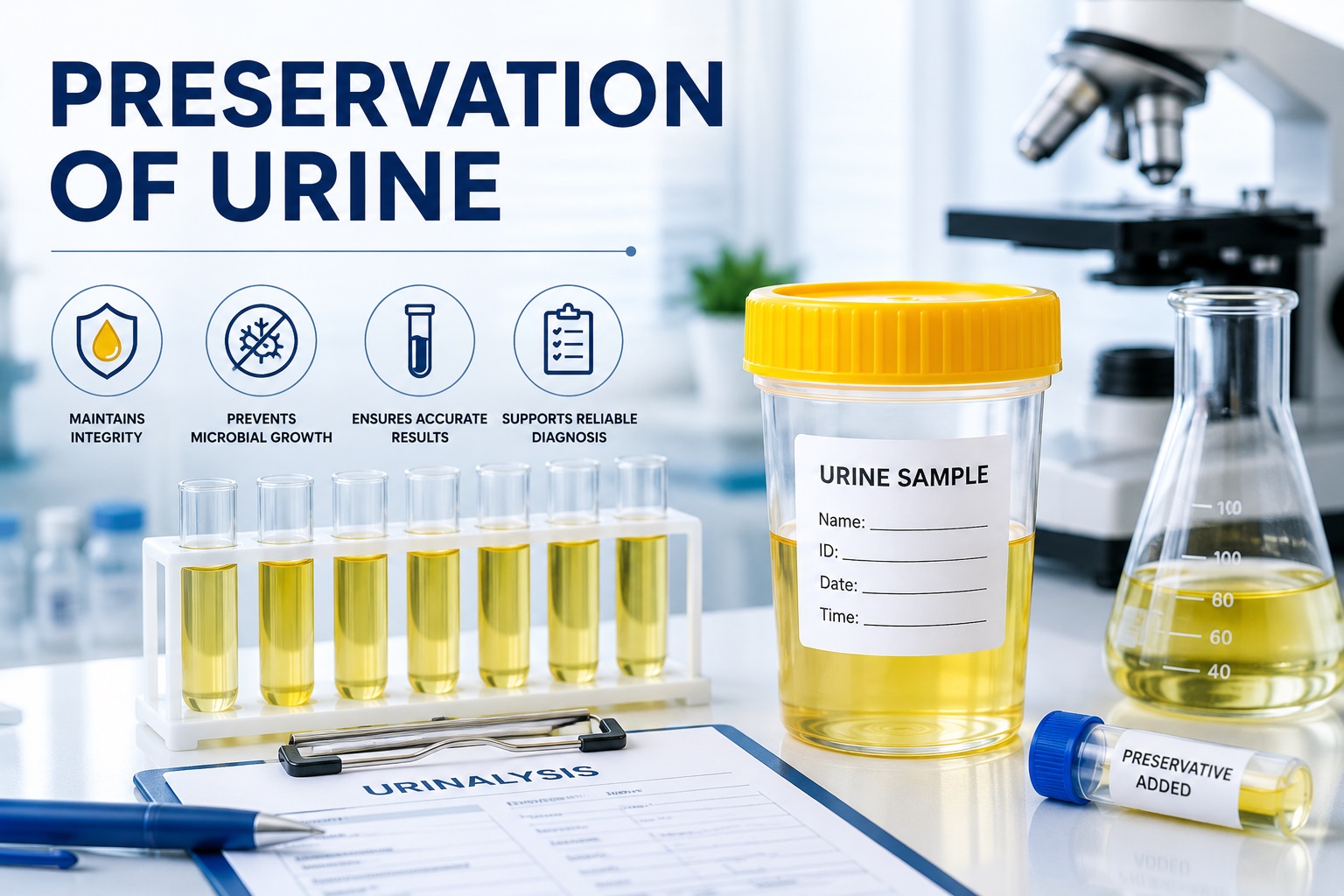
Ideally, urine should be examined within one to two hours after voiding. Fresh urine provides the most reliable information regarding its physical characteristics, chemical constituents, and microscopic elements. In many clinical situations, however, immediate analysis is not feasible. Delays may occur because of transportation from peripheral health centers, collection of 24-hour urine specimens, home-based sample collection, epidemiological studies, or referral laboratory testing. Under such circumstances, appropriate preservation becomes essential to maintain specimen integrity and prevent deterioration of clinically significant analytes. Proper urine preservation is therefore a critical component of the pre-analytical phase of laboratory testing and plays an important role in ensuring accurate diagnosis and patient management.
Basis of Urine Deterioration
Urine is a complex biological fluid containing water, electrolytes, metabolic waste products, proteins, hormones, enzymes, cells, casts, crystals, and microorganisms. After voiding, this dynamic mixture undergoes continuous biochemical and microbiological activity. Bacteria present in the specimen multiply rapidly, particularly when urine is stored at room temperature. These microorganisms utilize glucose and other nutrients as sources of energy, leading to a reduction in glucose concentration and alterations in the chemical composition of the specimen. Simultaneously, bacterial enzymes hydrolyze urea into ammonia, resulting in a progressive increase in urinary pH. This rise in alkalinity adversely affects the stability of formed elements such as red blood cells, white blood cells, and casts.
In addition to bacterial activity, exposure of urine to atmospheric oxygen initiates oxidation reactions that degrade several important urinary constituents. Bilirubin is oxidized to biliverdin, while urobilinogen is converted to urobilin, producing falsely decreased laboratory values. Light exposure further accelerates these photochemical reactions, particularly in specimens containing bile pigments and porphyrins. Volatile substances such as ketone bodies may evaporate during storage, leading to underestimation of their concentration. Enzymatic reactions continue after urine collection and contribute to the degradation of various metabolites and cellular components. Thus, without appropriate preservation, the composition of urine progressively changes, reducing the reliability of laboratory findings.
Changes Occurring in Unpreserved Urine
The deterioration of urine during storage manifests as physical, chemical, and microscopic alterations. Physically, the specimen gradually becomes more turbid because of bacterial proliferation, precipitation of crystals, and accumulation of cellular debris. The color may change owing to oxidation of urinary pigments, and a strong ammoniacal odor often develops as a result of bacterial decomposition of urea. These visible changes are frequently the first indications of specimen deterioration.
Chemical alterations are equally important and may significantly influence diagnostic interpretation. Glucose concentrations decrease because bacteria metabolize glucose as a nutrient source. Ketone bodies, particularly acetone, may be lost through volatilization. Bilirubin undergoes oxidation when exposed to air and light, whereas urobilinogen becomes unstable and gradually disappears. As bacterial hydrolysis of urea continues, ammonia production increases and urinary pH rises. These changes may produce falsely negative or misleading results in routine chemical testing.
Microscopically, the effects of prolonged storage are often profound. Red blood cells may undergo lysis, particularly in dilute or alkaline urine, while leukocytes progressively degenerate and lose their characteristic morphology. Casts, especially hyaline casts, become unstable and may dissolve completely. Bacterial multiplication may obscure other sediment elements, making microscopic interpretation difficult. Changes in pH and temperature may also promote crystal formation, resulting in sediment findings that were not originally present in the freshly voided specimen.
Objective of Urine Preservation
The primary objective of urine preservation is to maintain the specimen as close as possible to its original state at the time of collection. Effective preservation seeks to inhibit bacterial growth, reduce enzymatic activity, prevent oxidation of unstable constituents, and maintain the structural integrity of formed elements. No preservation method can completely prevent all changes from occurring; however, an appropriate preservation technique can significantly slow the deterioration process and extend the period during which reliable laboratory examination remains possible.
The choice of preservation method depends upon the intended laboratory investigation. A preservative suitable for microscopic examination may interfere with chemical testing, whereas a preservative designed for biochemical analysis may destroy cellular elements. Consequently, the laboratory must select preservation methods according to the analytes of interest and the anticipated duration of storage.
Methods of Urine Preservation
A. Refrigeration of Urine
Refrigeration is widely regarded as the most practical and effective method for preserving urine specimens intended for routine laboratory examination. Storage at temperatures between 2°C and 8°C slows bacterial multiplication, reduces enzymatic activity, and decreases the rate of chemical reactions responsible for specimen deterioration. Because refrigeration does not introduce foreign chemicals into the specimen, it is suitable for preserving most urinary constituents and is recommended whenever analysis will be delayed for several hours.
Although refrigeration effectively retards deterioration, it is not entirely without limitations. Cooling may promote precipitation of amorphous urates, phosphates, and other crystals, resulting in increased turbidity. These precipitates generally dissolve when the specimen is returned to room temperature before analysis. Nevertheless, refrigeration remains the preferred preservation method for routine urinalysis because it preserves both chemical and microscopic characteristics more effectively than most chemical preservatives.
B. Chemical Preservation of Urine
When refrigeration is not feasible or when urine must be stored for prolonged periods, chemical preservatives may be employed. Chemical preservation involves the addition of substances that inhibit bacterial growth, stabilize analytes, or preserve urinary sediment. No single preservative is suitable for all investigations, and each possesses distinct advantages and limitations.
Toluene has traditionally been used for preservation of large-volume urine collections because it forms a protective layer over the urine surface, reducing oxidation and minimizing contact with atmospheric air. Formalin is particularly useful for preserving cellular elements and casts and is therefore employed when microscopic examination is of primary importance. Boric acid is widely utilized for urine culture specimens because it prevents bacterial multiplication while maintaining the original bacterial population present in the specimen. Hydrochloric acid is used in selected biochemical investigations, particularly for preservation of catecholamines, steroid metabolites, and certain mineral analyses. Other preservatives, including thymol, chloroform, and sodium carbonate, may be employed for specialized purposes depending upon the analyte under investigation.
Table: Common Preservatives Used in Urine Analysis and Their Applications
| Preservative | Mechanism of Action | Recommended Amount | Major Uses | Advantages | Limitations / Interference |
|---|---|---|---|---|---|
| Refrigeration (2–8°C) | Slows bacterial growth, enzymatic activity, and chemical reactions | Not applicable | Routine urinalysis, chemical examination, microscopic examination | Most effective and widely recommended method; does not introduce foreign chemicals | May cause precipitation of amorphous urates and phosphates; specimen should be brought to room temperature before analysis |
| Toluene | Forms a protective layer on the urine surface, reducing exposure to air and oxidation | Approximately 2 mL per 100 mL urine | Routine chemical examination, protein estimation, 24-hour urine collections | Preserves many chemical constituents without significantly altering urine chemistry | Does not adequately inhibit existing bacterial growth; may interfere with some protein precipitation methods |
| Formalin (Formaldehyde) | Fixes and stabilizes cellular proteins by cross-linking | Approximately 1–2 mL per liter of urine | Preservation of urinary sediment, cells, and casts | Excellent preservation of formed elements and sediment morphology | Interferes with glucose, reducing substances, ketone bodies, and certain enzyme assays |
| Thymol | Acts as an antimicrobial agent by inhibiting bacterial growth | A few crystals or approximately 0.1 g per 100 mL urine | Chemical and microscopic examinations | Good preservative for both sediment and many chemical constituents | May interfere with protein determination and some chemical tests; excessive amounts may produce turbidity |
| Chloroform | Inhibits bacterial proliferation and reduces decomposition | Approximately 5 mL per liter or about 50 drops in a 24-hour collection | Preservation of chemical constituents and urinary sediment | Effective bacteriostatic action and long-term preservation | Toxic, hazardous to handle, and may interfere with glucose and ketone estimations |
| Boric Acid | Prevents bacterial multiplication while maintaining original bacterial counts | Usually 1–2% concentration | Urine culture and sensitivity testing | Preserves bacterial population during transportation and delayed processing | Excessive concentrations may affect some biochemical measurements |
| Hydrochloric Acid (HCl) | Acidifies urine, preventing bacterial growth and stabilizing acid-sensitive analytes | Approximately 10 mL concentrated HCl per 24-hour collection | Catecholamines, metanephrines, calcium, steroid metabolites, vanillylmandelic acid (VMA) | Excellent preservative for specialized biochemical investigations | Highly corrosive; destroys formed elements and unsuitable for routine microscopy |
| Sodium Carbonate | Maintains an alkaline environment and prevents oxidation of certain analytes | Variable depending on test requirements | Preservation of urobilinogen and porphyrins | Stabilizes analytes that deteriorate in acidic conditions | Not suitable for routine urinalysis and may alter urine pH significantly |
| Commercial Preservative Tablets | Combination of antimicrobial and stabilizing agents | As recommended by manufacturer | Large laboratory networks and transportation of specimens | Convenient, standardized, and minimizes handling errors | Composition varies among manufacturers; potential interference depends on formulation |
Because chemical preservatives may interfere with specific laboratory tests, their use should always be guided by established laboratory protocols and the requirements of the requested examination. Selection of Preservatives According to Laboratory Investigation
| Investigation | Preferred Preservative |
|---|---|
| Routine Urinalysis | Refrigeration |
| Microscopic Examination | Formalin |
| Urine Culture | Boric Acid |
| Protein Estimation | Toluene or Refrigeration |
| Glucose Determination | Refrigeration |
| Ketone Body Analysis | Refrigeration (fresh specimen preferred) |
| Catecholamine Estimation | Hydrochloric Acid |
| Calcium Estimation | Hydrochloric Acid |
| Steroid Metabolites | Hydrochloric Acid |
| Urobilinogen Determination | Sodium Carbonate |
| 24-Hour Biochemical Studies | Toluene or Appropriate Chemical Preservative |
| Long-Distance Transportation | Boric Acid or Commercial Preservative Tablets |
Important Note: No single preservative is ideal for all urine examinations. The choice of preservative should always be based on the analyte of interest, duration of storage, transportation requirements, and the analytical method used in the laboratory. This principle is fundamental to maintaining specimen integrity and ensuring accurate laboratory results.
Importance of Urine Preservation in Clinical Laboratory
Proper preservation of urine specimens is essential for ensuring analytical accuracy and maintaining the quality of laboratory services. Failure to preserve urine appropriately may result in false-positive findings, false-negative results, or complete loss of diagnostically important information. Such errors can lead to incorrect clinical interpretation, delayed diagnosis, inappropriate treatment, and unnecessary repeat testing. For this reason, urine preservation constitutes a fundamental aspect of quality assurance in laboratory medicine.
Modern laboratory quality management systems, including ISO 15189 standards, emphasize strict control of pre-analytical variables. Laboratories are therefore required to establish standardized procedures for specimen collection, preservation, storage, and transportation. Adherence to these procedures helps ensure that laboratory results accurately reflect the patient's clinical condition and support effective medical decision-making.
Urine preservation is an indispensable component of urinalysis and clinical laboratory practice. Since urine begins to undergo physical, chemical, and microbiological changes immediately after voiding, appropriate preservation techniques are necessary whenever immediate examination is not possible. By slowing bacterial growth, reducing chemical degradation, and maintaining the integrity of cellular elements, preservation methods help ensure that laboratory findings remain reliable and clinically meaningful. An understanding of the principles and methods of urine preservation is therefore essential for all healthcare professionals involved in specimen collection, laboratory testing, and patient care.
Bibliography
- Henry's Clinical Diagnosis and Management by Laboratory Methods. McPherson RA, Pincus MR (Editors). Elsevier; 2021.
- Tietz Fundamentals of Clinical Chemistry and Molecular Diagnostics. Burtis CA, Bruns DE (Editors). Elsevier; 2023.
- Tietz Textbook of Laboratory Medicine. Rifai N, Horvath AR, Wittwer CT (Editors). Elsevier; 2023.
- Clinical Diagnosis and Management by Laboratory Methods. McPherson RA, Pincus MR. Elsevier.
- Graff's Textbook of Urinalysis and Body Fluids. Mundt LA, Shanahan K. Wolters Kluwer/Lippincott Williams & Wilkins; 2015.
- Strasinger's Urinalysis and Body Fluids. Strasinger SK, Di Lorenzo MS. F.A. Davis Company; 2020.
- Clinical Laboratory Medicine. McClatchey KD. Lippincott Williams & Wilkins; 2017.
- Clinical Laboratory Science Review. Jarreau PB. Pearson Education; 2017.
- Clinical and Laboratory Standards Institute. Urinalysis; Approved Guideline. CLSI Document GP16 and current updates.
- International Organization for Standardization. ISO 15189:2022 – Medical Laboratories: Requirements for Quality and Competence.
- Textbook of Medical Laboratory Technology. Praful B. Godkar and Darshan P. Godkar. Bhalani Publishing House; Latest Edition.
- Medical Laboratory Technology Methods and Interpretations. Ramnik Sood. Jaypee Brothers Medical Publishers; Latest Edition.
- World Health Organization. Laboratory Quality Management System (LQMS) Handbook. Geneva: WHO.
- Bishop's Clinical Chemistry. Bishop ML, Fody EP, Schoeff LE. Wolters Kluwer; Latest Edition.
- Practical Clinical Biochemistry. Gowenlock AH, McMurray JR, McLauchlan DM. CBS Publishers & Distributors.